

Fewer than half of UK adults have made any formal provisions for a time when they may lose the ability to make their own decisions — yet the consequences of not doing so can be severe, costly, and deeply stressful for families. Understanding what a Lasting Power of Attorney is, and do you need one, is one of the most important steps you can take in planning for your future.
Key Takeaways
- A Lasting Power of Attorney (LPA) is a legal document that lets you appoint someone you trust to make decisions on your behalf.
- There are two distinct types: one for Property & Financial Affairs and one for Health & Welfare.
- An LPA must be registered with the Office of the Public Guardian before it can be used.
- You can only create an LPA while you still have mental capacity — waiting until a crisis occurs is too late.
- Without an LPA, your family may need to apply to the Court of Protection, which is significantly more expensive and time-consuming.
- LPAs are relevant at any adult age, not just in later life.
- Professional guidance ensures the documents are completed correctly the first time.
What Exactly Is a Lasting Power of Attorney?
A Lasting Power of Attorney is a legally binding document in which you (the “donor”) authorise one or more trusted individuals (your “attorneys”) to act on your behalf should you become unable to do so yourself. This inability may be temporary, such as following a serious accident, or permanent, as in the case of progressive conditions like dementia.
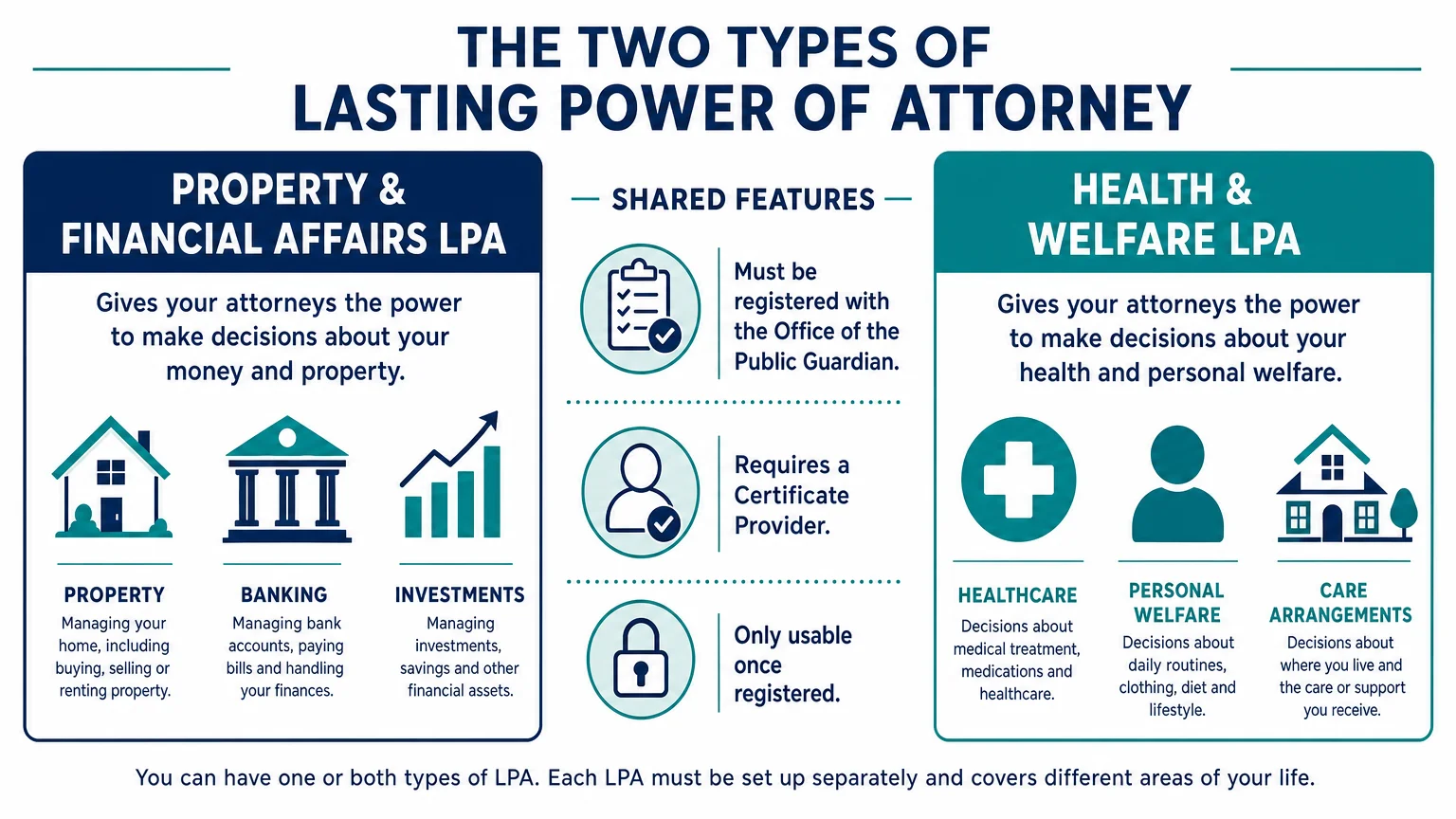
The LPA framework in England and Wales is governed by the Mental Capacity Act 2005, which establishes that decisions made by an attorney must always be in the donor’s best interests. The document must be signed by the donor, the attorney(s), and an independent certificate provider who confirms the donor understands what they are signing and is not under any pressure to do so. It must then be registered with the Office of the Public Guardian before it becomes legally valid and usable.
What Are the Two Types of LPA?
The two types of LPA serve fundamentally different purposes, and many people choose to put both in place.
1. Property & Financial Affairs LPA
This type authorises your attorney to manage the financial side of things. That includes bank accounts, paying bills, managing investments, collecting pension or benefit payments, and selling property if necessary. With your consent, this LPA can also be used while you still have capacity — useful if, for example, you are travelling abroad or recovering from surgery.
You can read more about this on our dedicated Power of Attorney for Property & Financial in Cwmbran page.
2. Health & Welfare LPA
This type gives your attorney the authority to make decisions about your personal care, medical treatment, and day-to-day welfare — including where you live and what care you receive. Crucially, it can only be used once you have lost mental capacity. It can also include a specific provision allowing your attorney to make decisions about life-sustaining treatment on your behalf.
Further detail on this type is available on our Power of Attorney for Health & Welfare page, including options for those in the Pontypool area.
| Feature | Property & Financial LPA | Health & Welfare LPA |
|---|---|---|
| Covers financial decisions | ✓ | ✗ |
| Covers medical/care decisions | ✗ | ✓ |
| Can be used with capacity | ✓ (with consent) | ✗ |
| Usable only after loss of capacity | Optional | ✓ |
| Must be registered with OPG | ✓ | ✓ |
Do You Actually Need a Lasting Power of Attorney?
The straightforward answer: if you are an adult with assets, a family, or health considerations, then yes — an LPA is almost certainly worth having. The question of what is a Lasting Power of Attorney and do you need one is not really about age; it is about preparation.
Consider these scenarios:
- You are involved in a serious accident and are temporarily incapacitated. Without an LPA, your partner cannot access your bank account to pay the mortgage.
- You are diagnosed with early-stage dementia. If you wait until the condition progresses, you may no longer have the legal capacity to sign an LPA.
The Mental Capacity Act 2005 makes it clear that capacity can be lost suddenly and without warning. An LPA is not a document for the elderly alone — it is a safeguard for any adult who wants their wishes respected and their affairs managed properly.
What Happens If You Don’t Have an LPA?
Without an LPA in place, no one — not even a spouse or adult child — has automatic legal authority to manage your affairs if you lose capacity. The only route available to your family is to apply to the Court of Protection for a Deputyship Order.
This process is:
- Significantly more expensive than setting up an LPA in advance.
- Time-consuming, often taking several months to resolve.
- Less flexible, as deputies are subject to ongoing court supervision and annual reporting requirements.
- Potentially distressing for family members already dealing with a difficult situation.
The advantages of having a power of attorney in place far outweigh the relatively modest effort of creating one while you have capacity. Prevention is considerably simpler than the alternative.
How Is an LPA Created and Registered?
Creating a valid LPA involves several defined steps, and any errors in the paperwork can result in the Office of the Public Guardian rejecting the application — causing delays and additional cost.
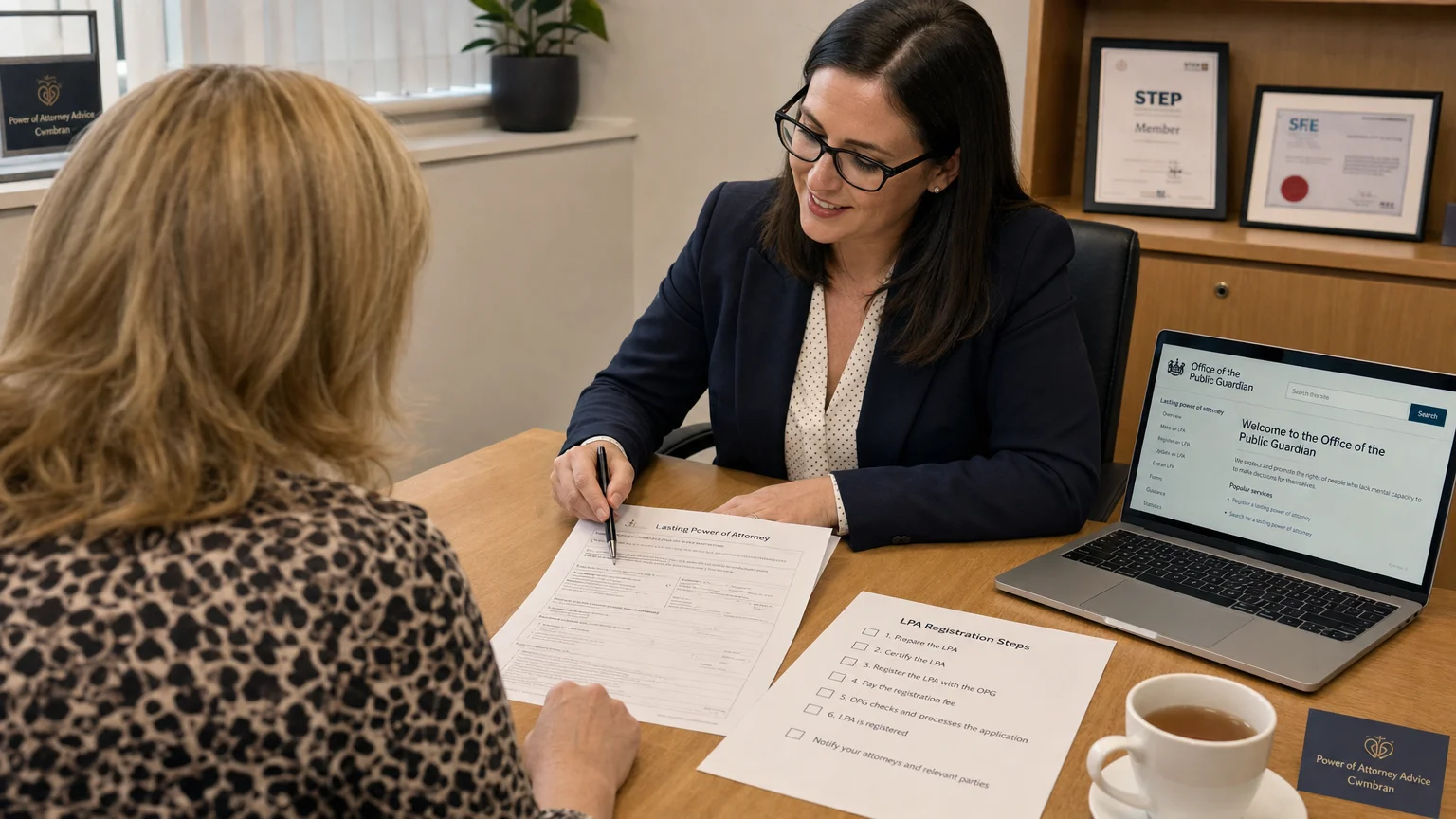
The process broadly follows these stages:
- Choose your attorney(s) — this should be someone you trust completely, whether a family member, close friend, or professional.
- Complete the LPA forms — there are separate forms for each type of LPA. These must be filled in precisely and in the correct order.
- Appoint a certificate provider — an independent person (not a family member) who confirms the donor’s understanding and consent.
- Sign the document — the donor, certificate provider, and attorney(s) must all sign in the correct sequence.
- Register with the Office of the Public Guardian — as of 2026, the registration fee in England and Wales is £92 per LPA (fee reductions or exemptions may apply in certain circumstances).
- Wait for confirmation — registration typically takes several weeks, after which the LPA is legally valid.
Working with experienced professionals, such as the team at Power of Attorney Advice in Cwmbran, ensures the documentation is completed correctly the first time. With over 25 years in financial services and qualifications including CeMAP, CeFA, and CeRER, the team provides a genuinely personalised, face-to-face service — as one client noted, it is a “face to face service and great help and advice.”
For a broader overview of the legal landscape, our guide to Powers of Attorney in the UK is a useful starting point.
Who Should You Appoint as Your Attorney?
Choosing the right attorney is arguably the most important decision in the entire process. Your attorney will have significant authority over your life, so the choice deserves careful thought.
Key qualities to look for:
- Absolute trustworthiness and integrity
- The ability to act in your best interests, even under pressure from others
- Good organisational skills, particularly for a financial LPA
- Willingness to take on the responsibility
- Ideally, someone who understands your values and wishes
You may appoint more than one attorney, and you can specify whether they must act jointly (all decisions made together) or jointly and severally (each can act independently). You can also appoint replacement attorneys in case your first choice is unable to act.
Can an LPA Be Changed or Cancelled?
Yes — provided you still have mental capacity, you can cancel (revoke) an LPA at any time. You can also make a new LPA if your circumstances change, for example if a previously appointed attorney passes away or if your relationship with them changes significantly.
Once capacity is lost, however, the LPA cannot be altered. This reinforces why acting sooner rather than later is so important. If you have any concerns about an existing LPA — or wish to update your arrangements — get in touch with the team to discuss your options.
Taking the Next Step
Understanding what is a Lasting Power of Attorney and do you need one is the first step — acting on that understanding is what truly protects you and your family. An LPA is not a document to put off until later; it is a practical, responsible measure that gives you control over your future and spares your loved ones considerable difficulty.
At Power of Attorney Advice in Cwmbran, Gwent, the team offers a personalised, face-to-face service backed by over 25 years of experience in financial services and professional qualifications including CeMAP, CeFA, and CeRER. Whether you need a Property & Financial Affairs LPA, a Health & Welfare LPA, or both, professional guidance is only a phone call or email away.
Contact the team today to arrange a conversation about your circumstances and take the first step towards genuine peace of mind.
Frequently Asked Questions
What is a Lasting Power of Attorney in simple terms?
A Lasting Power of Attorney is a legal document that lets you choose someone you trust to make decisions on your behalf if you become unable to do so yourself. It covers either financial matters, health and welfare decisions, or both, depending on which type you set up.
Do I need an LPA if I am married or in a civil partnership?
Yes. A spouse or civil partner does not automatically have the legal right to manage your finances or make healthcare decisions for you if you lose mental capacity. Without an LPA, they would need to apply to the Court of Protection, which is a lengthy and costly process.
At what age should I make an LPA?
There is no single correct age — any adult over 18 can and should consider making an LPA. Accidents and sudden illness can affect people of any age, and you must have mental capacity at the time of signing, so it is wise not to wait.
How long does it take to register an LPA?
Registration with the Office of the Public Guardian typically takes several weeks once the completed forms are submitted. It is advisable to begin the process well in advance of any anticipated need.
What is the difference between a Lasting Power of Attorney and an Enduring Power of Attorney?
Enduring Powers of Attorney (EPAs) were replaced by LPAs in October 2007. EPAs made before that date remain valid, but no new EPAs can be created. If you have an older EPA, it may be worth reviewing whether an LPA would better suit your current circumstances.
Can I have more than one attorney?
Yes. You can appoint multiple attorneys and specify how they should make decisions — either jointly, jointly and severally, or a combination of both. You can also name replacement attorneys in case your primary choice is unable to act.
What happens if my LPA application is rejected?
The Office of the Public Guardian can reject an LPA application if the forms contain errors, are signed in the wrong order, or do not meet legal requirements. Working with a professional service significantly reduces this risk and ensures the documents are completed correctly first time.
How much does it cost to set up an LPA?
As of 2026, the registration fee is £82 per LPA in England and Wales, meaning £164 for both types. Fee reductions or exemptions may be available depending on your financial circumstances. Professional fees for assistance with preparation vary — contact [Power of Attorney Advice](/contact) for details specific to your situation.
Contributing writer at Power of Attorney Advice.