

Nearly one in three Lasting Power of Attorney (LPA) applications submitted to the Office of Public Guardian contains an error that causes delays or rejection. Knowing exactly what to check before signing your power of attorney documents can save you weeks of frustration — and in some cases, prevent a document from being legally valid at all. This friendly guide walks you through 10 essential checks so you can sign with confidence.
Key Takeaways
- An LPA must be registered with the Office of Public Guardian before it can be used — signing alone is not enough.
- There are two types of LPA: one for Property & Financial Affairs and one for Health & Welfare — you may need both.
- Every section must be completed in the correct order; signing out of sequence invalidates the document.
- Attorneys, certificate providers, and witnesses all have specific eligibility rules that must be met.
- Errors on LPA forms can cause significant delays, so getting professional guidance before signing is strongly recommended.
- Power of Attorney Advice in Cwmbran, Gwent, has over 25 years of experience helping families get these documents right first time.
Why Does Getting Your LPA Right Matter So Much?
An LPA is one of the most important legal documents you will ever sign. It grants another person — your attorney — the legal authority to make decisions on your behalf if you lose mental capacity. Unlike a will, which takes effect after death, an LPA operates during your lifetime, which means any errors can have real, immediate consequences for you and your family.
The good news is that most mistakes are entirely avoidable. Working through a clear checklist before signing your power of attorney documents means you can catch problems early, before they become costly. For a broader overview of what an LPA involves, our guide to Powers of Attorney in the UK is a helpful starting point.
What Are the 10 Things to Check Before Signing Your Power of Attorney Documents?
Whether you are completing the forms yourself or working with a professional, these are the ten areas where errors most commonly occur.
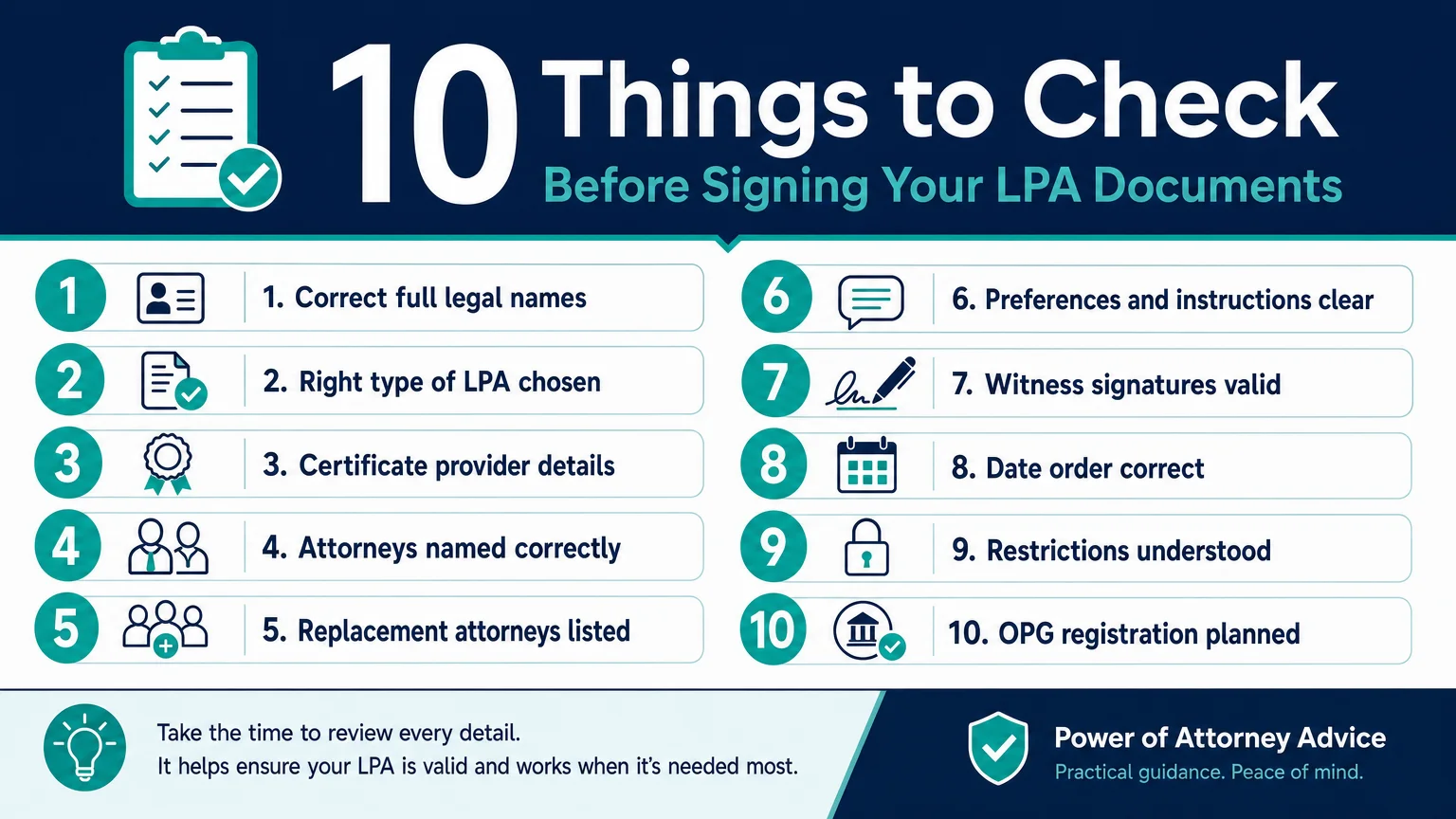
1. Have You Chosen the Right Type of LPA?
There are two distinct types of Lasting Power of Attorney, and they cover entirely different areas of your life. A Property & Financial Affairs LPA covers things like managing bank accounts, paying bills, and selling property. A Health & Welfare LPA covers medical decisions, care arrangements, and day-to-day personal welfare. Many people need both. Check that you have completed the correct form(s) for your circumstances.
2. Are All Names Recorded Exactly as They Appear on Official Documents?
Every person named in the LPA — the donor (that is you), each attorney, and any replacement attorneys must be identified using their full legal name, exactly as it appears on their passport or birth certificate. A nickname, a shortened version, or an outdated name can cause the Office of Public Guardian to query or reject the application.
3. Is Your Certificate Provider Eligible and Independent?
The certificate provider is the person who signs to confirm you understand what you are signing and are not being pressured. This is a critical safeguard. They must be either a professional (such as a solicitor or GP) or someone who has known you personally for at least two years. They cannot be a family member, an attorney named in the document, or anyone who lives with you. Confirm their eligibility before proceeding.
4. Have Your Attorneys Been Named Correctly?
Your attorneys must be adults (aged 18 or over) and, for a Property & Financial Affairs LPA, must not be subject to a Debt Relief Order or bankruptcy. Check that each attorney’s full name, date of birth, and address are recorded accurately. Even a small error here — a wrong postcode, for example — can trigger a query from the Office of Public Guardian.
5. Have You Decided How Your Attorneys Should Act?
You must specify whether your attorneys should act “jointly” (all together on every decision), “jointly and severally” (independently or together), or “jointly for some decisions and jointly and severally for others.” This is not a small administrative detail — it affects how practical and workable the LPA is in everyday life. Think carefully about what suits your situation and the people you have chosen.
6. Have You Included Any Preferences or Instructions?
The LPA form includes space for preferences (guidance you would like your attorneys to follow) and instructions (directions they must follow). These are optional but can be extremely useful. However, any instruction that contradicts the law or is impossible to carry out will cause the application to be returned. If you include instructions, make sure they are clear, lawful, and realistic.
7. Are Replacement Attorneys Listed if Needed?
If one of your attorneys can no longer act — due to death, loss of capacity, or stepping down — what happens? Without a replacement attorney named in the document, the LPA may fail if your only or last remaining attorney cannot continue. Consider whether naming a replacement gives you an important safety net.
8. Have All Signatures Been Witnessed Correctly?
The rules around witnessing are strict. Your signature must be witnessed by someone who is not an attorney or replacement attorney named in the document. Attorneys’ signatures must also be witnessed, and the same witness restrictions apply. The witness must be present in person when you sign — a remote or retrospective witness is not valid.
9. Has the Document Been Signed in the Correct Order?
This is one of the most common reasons LPAs are rejected. The sections must be signed in a specific sequence: the donor signs first, then the certificate provider, then the attorneys. If the attorneys sign before the certificate provider, the document is invalid. Check the date order of all signatures carefully before submission.
10. Is Registration with the Office of Public Guardian Planned?
Signing the LPA is not the final step. The document must be registered with the Office of Public Guardian before it can be used. Registration currently takes several weeks, so it is wise to submit the application promptly after signing. An unregistered LPA has no legal effect, no matter how carefully it was completed.
What Happens If You Miss Something Before Signing?
Errors discovered after signing can sometimes be corrected, but this depends on the nature of the mistake and when it is caught. Minor clerical errors may be correctable with a simple amendment. More significant errors — such as signatures in the wrong order or an ineligible certificate provider — may require the entire document to be restarted from scratch.
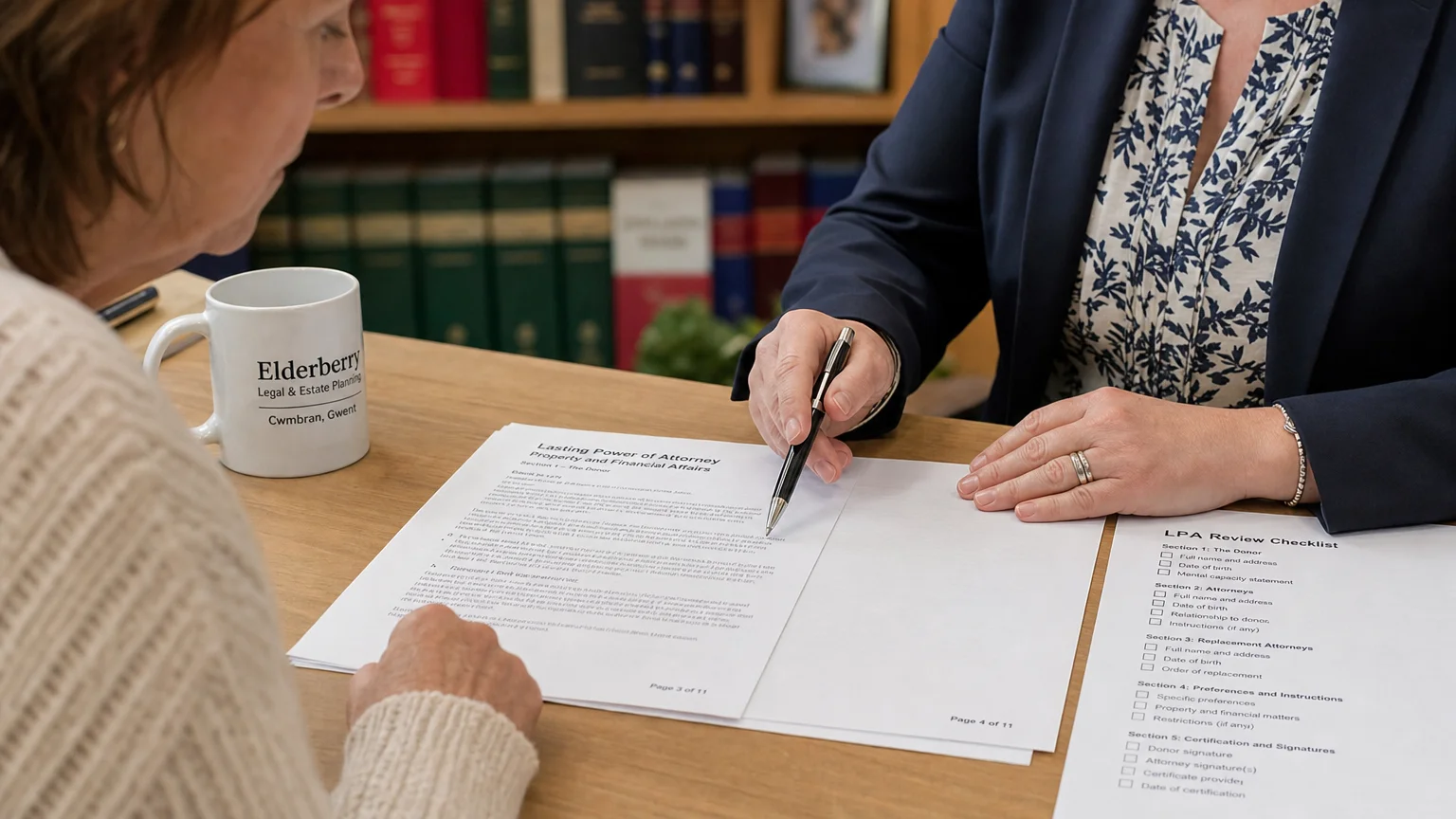
This is precisely why getting professional guidance before signing your power of attorney documents is so valuable. At Power of Attorney Advice in Cwmbran, the team reviews documents carefully with clients to make sure everything is in order before a single signature goes down. With professional indemnity cover of up to £2 million and qualifications including CeMAP, CeFA, and CeRER, clients can feel confident their documents are in capable hands. As one client put it: “Face to face service and great help and advice.”
Should You Use a Professional or Complete the LPA Yourself?
Both routes are available. The Office of Public Guardian provides forms and guidance online, and some people do complete LPAs without professional help. However, the complexity of the rules — particularly around signing order, certificate providers, and attorney eligibility — means that errors are common among self-completers.
A professional service, such as Lasting Power of Attorney advice from Power of Attorney Advice, provides a tailored approach. Every individual’s situation is different, and what suits one person may not suit another. A personalised service means your document reflects your specific wishes, your family circumstances, and your long-term plans.
For families in Pontypool and the surrounding area, Lasting Power of Attorney in Pontypool and Power of Attorney for Health & Welfare in Pontypool are also available.
A Quick Pre-Signing Checklist
Use this table as a final sense-check before you sign:
| Check | Done? |
|---|---|
| Correct type of LPA selected | ☐ |
| Full legal names used throughout | ☐ |
| Certificate provider is eligible and independent | ☐ |
| Attorneys named correctly with full details | ☐ |
| Attorneys’ decision-making arrangement specified | ☐ |
| Preferences and instructions are clear and lawful | ☐ |
| Replacement attorneys considered | ☐ |
| Witnesses are eligible and present in person | ☐ |
| Signatures completed in the correct order | ☐ |
| OPG registration planned and submitted promptly | ☐ |
Ready to Get Your LPA Documents Right First Time?
Checking these 10 things before signing your power of attorney documents could save you significant time, cost, and stress. Whether you are just starting to think about an LPA or you have forms in front of you and want a professional to review them, Power of Attorney Advice in Cwmbran is here to help.
Get in touch with the team today for a friendly, no-pressure conversation about your circumstances. You can also explore the advantages of having a power of attorney to understand why so many families across Gwent are taking this important step now rather than later.
Frequently Asked Questions
How long does it take to register an LPA with the Office of Public Guardian?
Registration typically takes several weeks from the date the application is received. The Office of Public Guardian must notify certain people before completing registration, which adds to the timeline. It is best to apply as soon as possible after signing.
Can I make changes to my LPA after it has been signed?
Minor clerical errors can sometimes be corrected using a prescribed method before registration. However, once registered, the LPA cannot be amended — a new document would need to be created. This is why checking everything carefully before signing is so important.
Does an LPA come into effect as soon as it is signed?
No. An LPA must be registered with the Office of Public Guardian before it can be used. A signed but unregistered LPA has no legal effect.
Can a family member be my certificate provider?
No. A certificate provider must be independent. Family members, people who live with you, and anyone named as an attorney in the document are all ineligible. They must be either a professional who knows you in that capacity, or someone who has known you personally for at least two years.
What is the difference between a Property & Financial Affairs LPA and a Health & Welfare LPA?
A Property & Financial Affairs LPA allows your attorney to manage financial matters such as bank accounts, investments, and property. A Health & Welfare LPA allows your attorney to make decisions about your medical care, living arrangements, and day-to-day welfare. Many people choose to create both.
Can I have more than one attorney?
Yes. You can appoint multiple attorneys and specify how they should act — jointly, jointly and severally, or a combination. You can also name replacement attorneys in case one is unable to continue.
What qualifications does Power of Attorney Advice hold?
The team holds CeMAP, CeFA, and CeRER qualifications and carries Professional Indemnity cover of up to £2 million. The business has been providing financial and legal planning services for over 25 years.
Is it too early to set up an LPA if I am still young and healthy?
Not at all. An LPA can only be created while you have mental capacity — it cannot be set up after capacity is lost. Setting one up while you are well means it is ready if it is ever needed, without any urgency or pressure.
Contributing writer at Power of Attorney Advice.